ABSTRACT
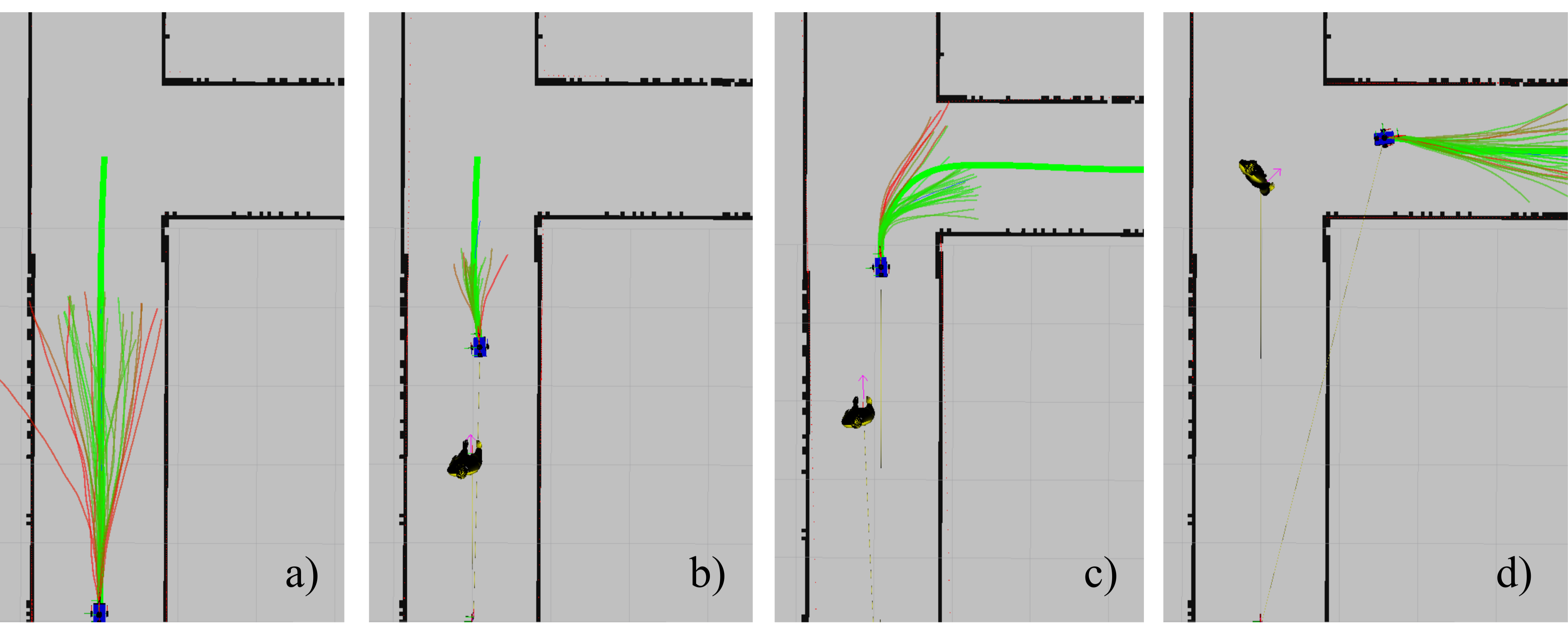
Frontal following, in which a mobile robot moves ahead of a walking person while remaining a navigational follower, suffers from trajectory instability when predicted human positions are treated as navigation goals. The resulting path oscillates in straight corridors, and exit selection becomes unstable at junctions. At decision points, route intent cannot be determined with certainty from physical cues alone. A Hierarchical Supervisory Motion Planning (HSMP) framework is proposed that integrates Dynamic Virtual Rail (DVR)-based path generation, supervisory junction resolution, and Guided Model Predictive Path Integral (Guided-MPPI) trajectory optimization. The robot follows a DVR that derives path geometry from environmental structure rather than predicted human positions, thereby decoupling trajectory planning from human kinematics. Human state is estimated using an Extended Kalman Filter (EKF). Concurrently, supervisory commands dictate exit selection at junctions while the robot executes collision-avoiding paths. Guided-MPPI preserves line of sight during turns through a rear-facing field-of-view cost, and a Kinematic Predictive Controller (KPC) regulates formation distance. Execution velocity is decoupled from trajectory geometry, preventing corner-cutting during deceleration while preserving geometric validity across speed changes. Experiments demonstrate deterministic exit selection, improved trajectory stability with DVR, and reduced corner-cutting during low-speed turns.
Keywords— frontal following, supervisory control, MPPI, ROS 2, mobile robot following, human-robot interaction, KPC, EKF, formation control, following in front
I. INTRODUCTION
Existing work on person-following robots has focused mainly on the robot-behind-human (following from behind) configuration, leaving the forward-leading paradigm (following from the front) underexplored despite its practical relevance in guidance and navigation assistance. Frontal following is useful in applications such as smart luggage carriers, tool carriers, and telepresence avatars. It inverts the control relationship: physically, the robot leads, but navigationally, it follows the human's trajectory intent without knowing the exact destination.
Current solutions are either reactive (safe but high user effort) or predictive (low user effort but lacking certainty, with trajectory flickering for users' micro movements). The root cause is fundamental. Treating predicted human positions as navigation goals creates flickering from side-to-side drift. In corridors, if a human steps left (e.g., to avoid a smudge, to look at a sign, or to talk to someone), a predictive planner steers left; the human corrects right; the planner follows. At junctions, small heading variations cause oscillation between exits.
Frontal following therefore contains three coupled but distinct problems: stable path generation in constrained corridors, reliable intent resolution at topological ambiguities, and geometry-preserving execution during speed changes. Trajectory geometry should be anchored to environmental structure rather than noisy human motion. Meanwhile, route selection at ambiguous junctions should not rely solely on probabilistic inference, because physical cues may not align with the user's intended path and therefore cannot guarantee certainty. Practical indoor operation therefore requires explicit supervisory input for deterministic junction resolution while preserving autonomous trajectory generation and collision avoidance. Yet explicit commands alone are insufficient: once a branch is selected, the robot still requires a geometrically valid path that can be followed smoothly through corridors, turns, and multi-exit junctions.
This paper addresses these requirements through a hierarchical frontal-following framework. The contributions are: (1) Dynamic Virtual Rail (DVR) with command latching, which derives paths from environmental structure and uses a local cubic Bézier trajectory for off-rail recovery; (2) supervisory motion planning, which latches commands issued before or at a junction and stitches entry and exit segments into a deterministic route for Guided Model Predictive Path Integral (Guided-MPPI); and (3) a velocity-geometry decoupling filter that coordinates KPC-constrained execution speed with Guided-MPPI trajectory commands to preserve planned curvature during speed reductions and prevent corner-cutting.