RESEARCH
Publications & Interests
> Selected Publications
Hierarchical Supervisory Motion Planning for Frontal Following Mobile Robots Using Guided Model Predictive Path Integral and Dynamic Virtual Rail
MERCon 2026
Authors: Shakila Praveen Rathnayake
Supervisors: Dr. B. G. D. A. Madhusanka, G. M. K. B. Karunasena, and R. A. K. K. Perera
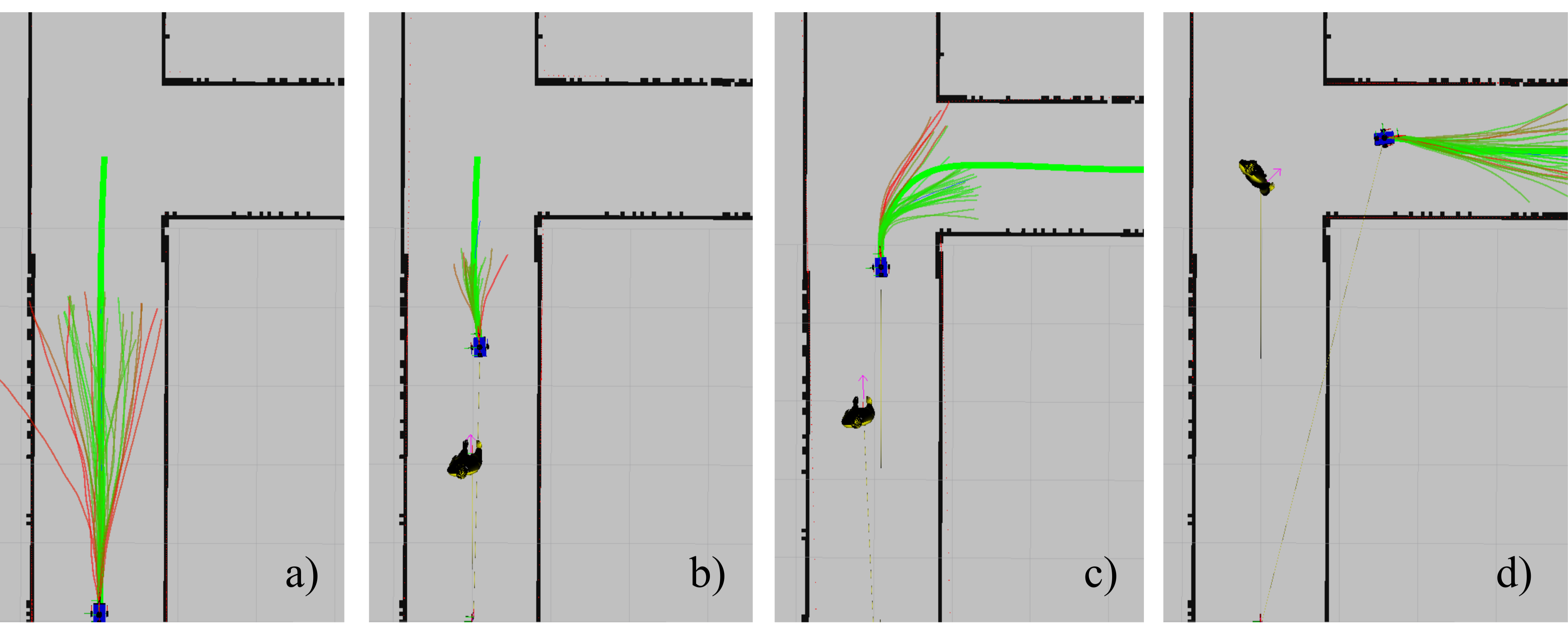
Frontal following, in which a mobile robot moves ahead of a walking person while remaining a navigational follower, suffers from trajectory instability when predicted human positions are treated as navigation goals. The resulting path oscillates in straight corridors, and exit selection becomes unstable at junctions. At decision points, route intent cannot be determined with certainty from physical cues alone. A Hierarchical Supervisory Motion Planning (HSMP) framework is proposed that integrates Dynamic Virtual Rail (DVR)-based path generation, supervisory junction resolution, and Guided Model Predictive Path Integral (Guided-MPPI) trajectory optimization. The robot follows a DVR that derives path geometry from environmental structure rather than predicted human positions, thereby decoupling trajectory planning from human kinematics. Human state is estimated using an Extended Kalman Filter (EKF). Concurrently, supervisory commands dictate exit selection at junctions while the robot executes collision-avoiding paths. Guided-MPPI preserves line of sight during turns through a rear-facing field-of-view cost, and a Kinematic Predictive Controller (KPC) regulates formation distance. Execution velocity is decoupled from trajectory geometry, preventing corner-cutting during deceleration while preserving geometric validity across speed changes. Experiments demonstrate deterministic exit selection, improved trajectory stability with DVR, and reduced corner-cutting during low-speed turns.
Enhancing Accuracy in Automated Solid Waste Segregation
Research Proposal
Authors: W. M. S. P. Rathnayake
This research investigates the potential for improving the accuracy and efficiency of automated solid waste segregation systems by integrating multiple sensors with a cross-verification mechanism. Current systems, which typically rely on single-method technologies, often fall short when handling the complexity and variability of non-organic waste streams, resulting in high contamination rates and reduced recycling efficiency. By developing and testing a multi-sensor approach, this study aims to achieve a high sorting accuracy in real-world conditions.
RESEARCH_INTERESTS
- + Autonomous Navigation in Unstructured Environments
- + Human-Robot Interaction & Social Navigation
- + Multi-Agent Systems & Swarm Robotics
- + Computer Vision for specialized domains (Underwater, Aerial)
- + Embedded Systems & Real-time Control
COLLABORATION
Open to research collaborations in robotics, machine vision, AI and embedded systems.
Contact Me